What is EECP Treatment?
A Simple Explanation
A note from Dr. Shikha Agarwal (PhD), Clinical Researcher & Administrator, FHCC: At FHCC, we see patients every week who arrive scared, confused, and full of questions. Questions like: 'Is bypass surgery really the only way?' 'What is this EECP treatment my neighbour told me about?' 'Is it safe for someone my age?' 'Can it actually help when my arteries are blocked?' This guide answers all of those questions — honestly, in plain language, the way we would explain it to a family member sitting across from us.
My name is Dr. Shikha Agarwal (PhD). I am a Clinical Researcher with 24 years of experience in Diabetes Reversal and Non-Invasive Preventive Cardiology, and one of the Administrators at FHCC. My research focuses on understanding and predicting lifestyle diseases — especially the dangerous overlap of diabetes and heart disease — through innovative methods like Pulse Rate Variability (PRV) analysis. I have worked alongside hundreds of EECP patients at FHCC since 2015. I have seen patients arrive as a last resort — told surgery was too risky — walk out after 35 sessions with a quality of life they had not experienced in years. This guide is written from that clinical experience, for Indian patients who deserve clear and honest information.
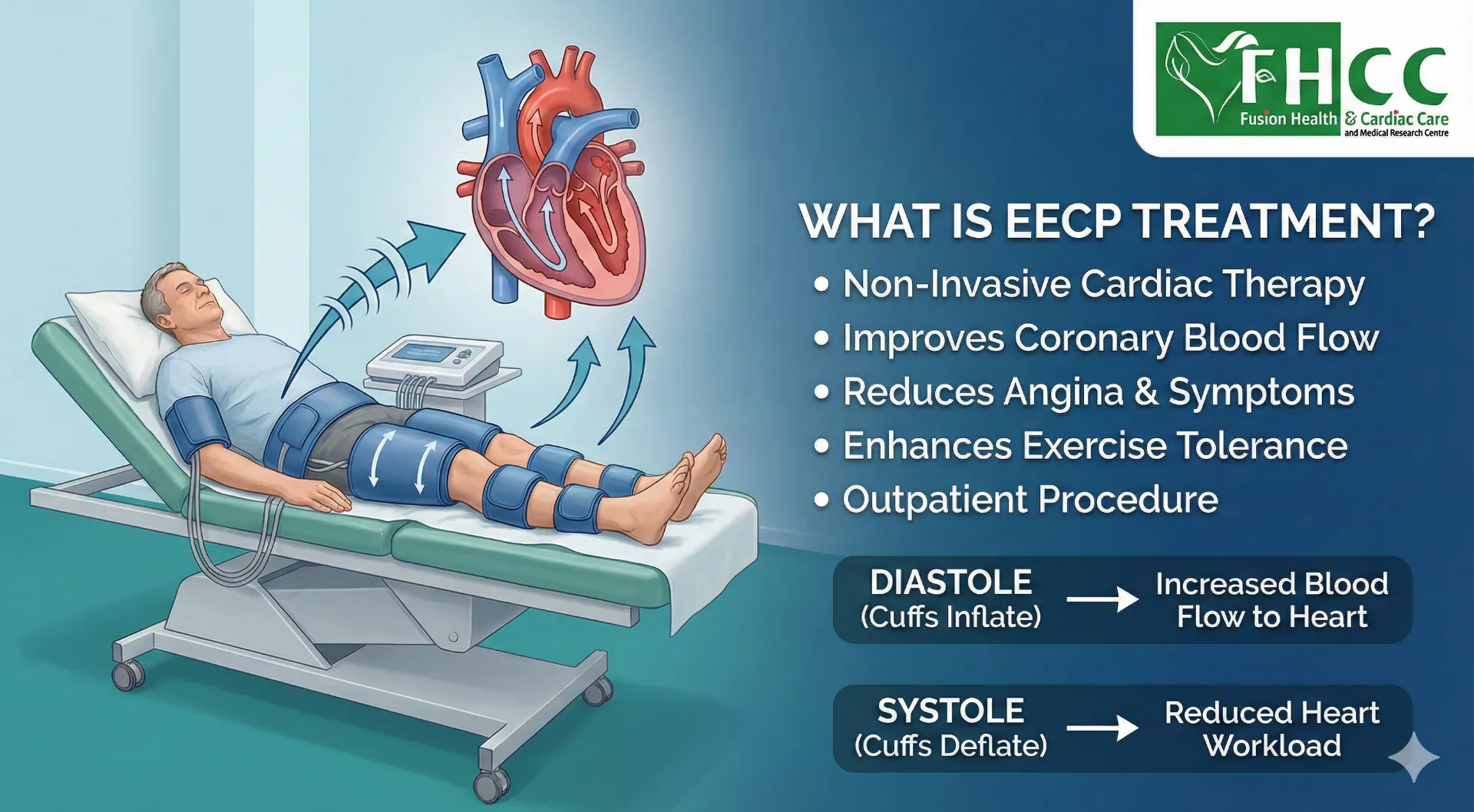
EECP stands for Enhanced External Counterpulsation. Let us break that down in plain language:
- Enhanced = improved, boosted
- External = from outside the body — no surgery, no opening of the chest
- Counterpulsation = working in rhythm with the heartbeat, but in the opposite direction to give the heart extra help
In simple terms: EECP is a therapy where special pressure cuffs are wrapped around your thighs, calves, and buttocks. These cuffs inflate and deflate in perfect synchronisation with your heartbeat — detected by ECG leads attached to your chest. The inflation pushes blood back towards the heart exactly when the heart is resting (diastole). The deflation releases pressure exactly when the heart pumps (systole). This gives the heart more blood when it needs it and less resistance when it is pumping.
Think of it like this: Imagine your heart is a water pump that is getting tired. The pump's pipes (coronary arteries) are partly blocked. EECP is like sending extra water through a side pipe during the pump's rest phase — giving it more supply and less work. Over 35 sessions, the body actually begins to grow new side pipes (collateral vessels) naturally. This is why patients who complete a full course feel lasting benefit — not just temporary relief.
Ramesh Ji, 67 years, came to us from Navi Mumbai. He had triple vessel CAD and was told he needed bypass surgery. He had diabetes and his creatinine was slightly high — which made his surgeons hesitant. After completing his EECP course at FHCC, his treadmill test improved from 3 METs to 7 METs. He is now walking 4 km daily. His exact words: "Doctor sahab, mujhe lagta tha main ab kabhi seedha chal nahi paunga."
— Ramesh K., 67, Navi Mumbai | Triple Vessel CADEECP Full Form & History
EECP Full Form: Enhanced External Counterpulsation. It is also written as ECP in some medical literature, though EECP is the internationally recognised and FDA-approved full form used today.
Who Invented EECP Therapy?
EECP therapy was originally developed in the 1950s at Harvard Medical School and refined over decades. The modern form of EECP treatment was developed and validated by researchers at the State University of New York (SUNY) in the 1980s–90s. The landmark MUST-EECP trial, published in the Journal of the American College of Cardiology, demonstrated its clinical effectiveness for angina — leading to US FDA approval in 1995 for angina and later for heart failure. It is the same technology we use at FHCC today.
Is EECP Treatment Available in India?
Yes — and FHCC has been one of the pioneers in bringing clinical-grade EECP Treatment to India since 2015. What makes FHCC different is that our EECP treatment is not just delivered by technicians — it is supervised by qualified cardiologists who assess each patient individually and customise every treatment course.
How Does EECP Help?
The Science Behind the Therapy
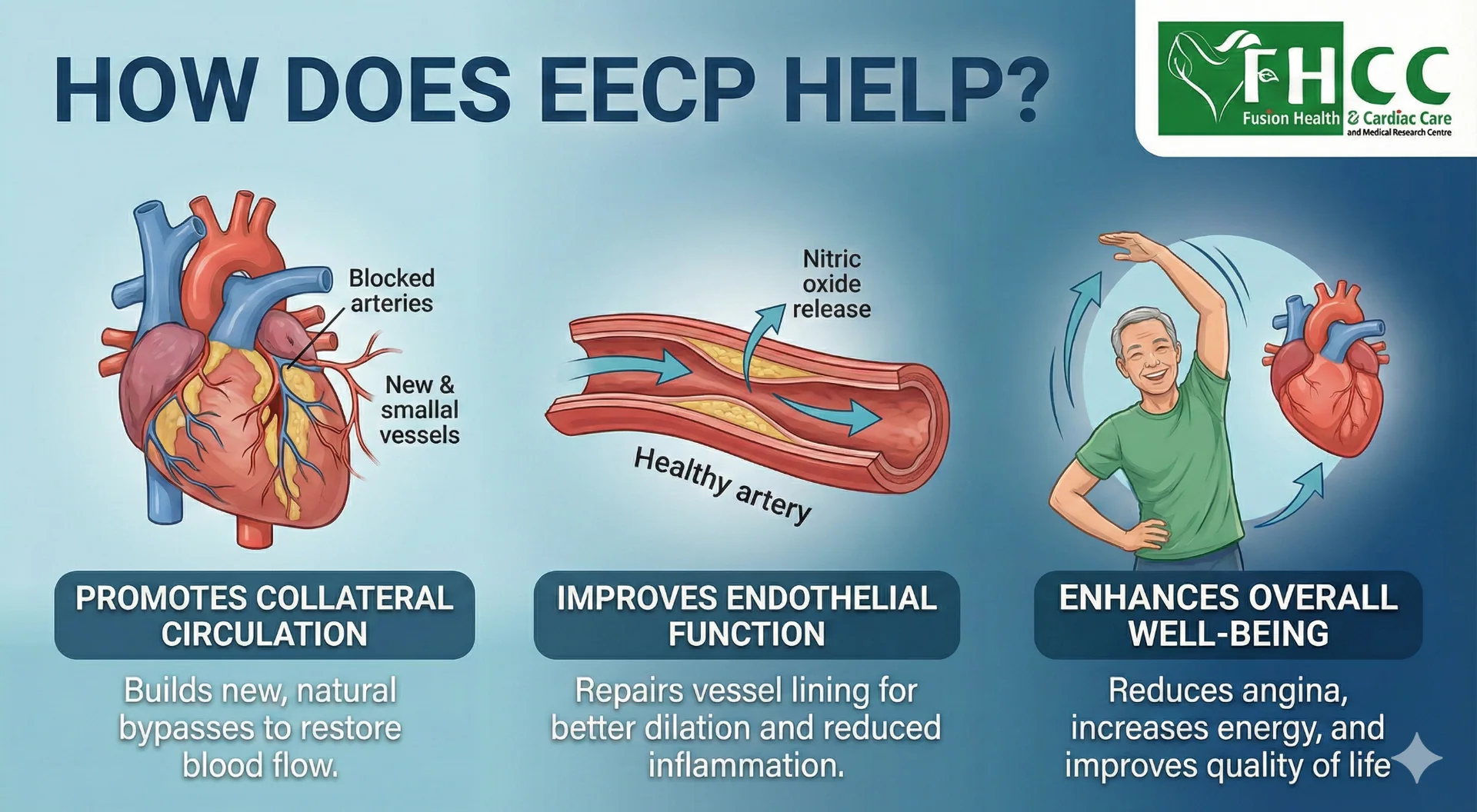
This is the question we get most often at FHCC: "Doctor, explain to me — if no medicine is going in and no surgery is happening, how exactly is this treatment helping my heart?"
The answer involves four distinct mechanisms — each clinically studied and documented:
Sunita ji, 71 years, from Borivali. She had been on 5 different heart medications for 3 years and still got breathless walking from her bedroom to the kitchen. After session 15 of her EECP course at FHCC, she told us: "Pehli baar lift ki jagah seedhi stairs chadh ke aayi clinic." By session 35, she had stopped two of her medications on her cardiologist's advice. Her echo showed her ejection fraction had improved from 38% to 51%.
— Sunita M., 71, Borivali | Chronic Heart Failure + 5-drug regimeWhat Conditions Does EECP Therapy Treat?
EECP treatment is clinically indicated for:
- Chronic Stable Angina (chest pain that recurs with exertion)
- Heart Failure — especially in cases where ejection fraction is reduced
- Coronary Artery Disease (CAD) — including multi-vessel disease
- Post-Heart Attack Recovery and Cardiac Rehabilitation
- Patients who are not candidates for bypass surgery or angioplasty
- Patients with recurrent symptoms after bypass or stenting
- Diabetic heart disease with microvascular complications
- High blood pressure (hypertension) and its cardiac effects
- Patients with kidney disease who cannot safely undergo contrast-based procedures
EECP Treatment Procedure
What Happens, Step by Step
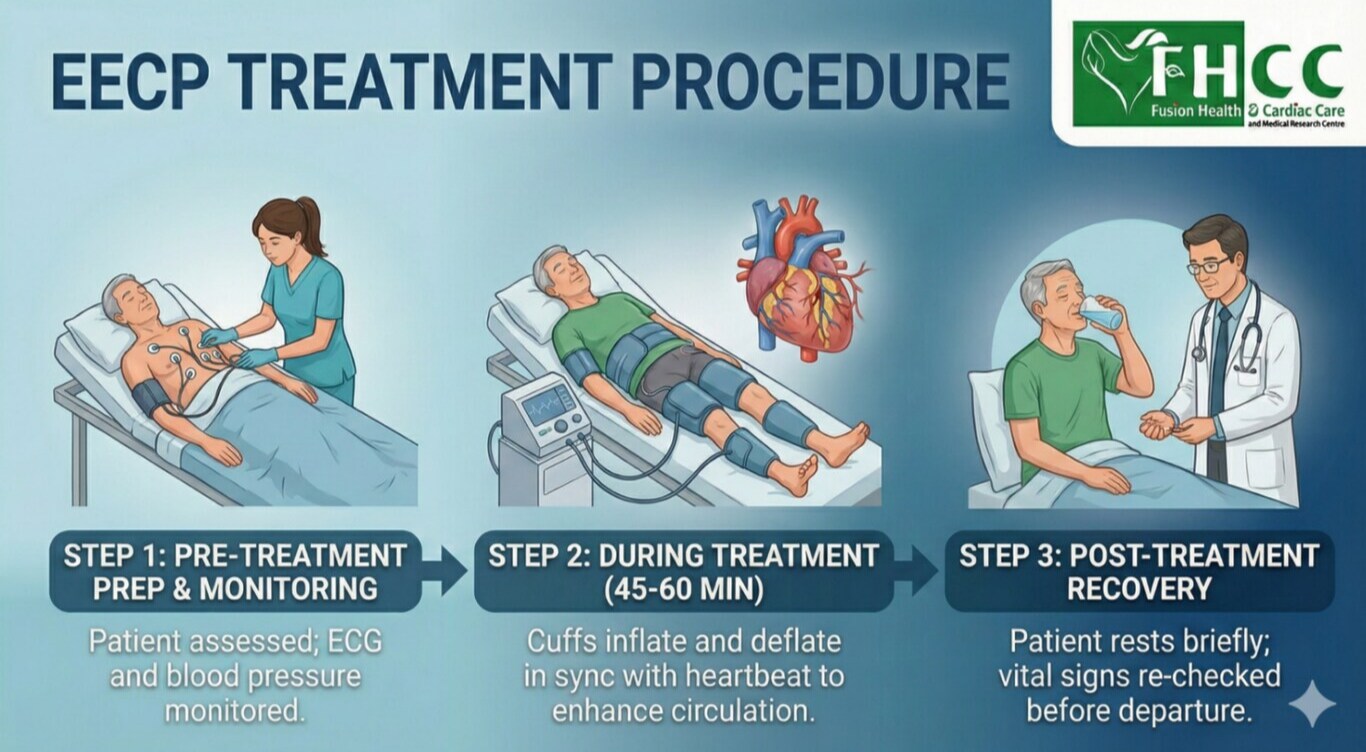
One of the biggest fears patients have before starting EECP is the unknown. "What will it feel like? Will it be painful? What happens if something goes wrong?" At FHCC, we spend time before the first session explaining every step — because a relaxed, informed patient responds better to therapy.
Before You Start — Initial Cardiac Assessment
Before your first EECP session, our cardiologist will conduct:
- A detailed review of your medical history and previous tests (ECG, Echo, Angiography reports)
- Blood pressure and oxygen saturation check
- A resting ECG (electrocardiogram)
- A clinical examination to confirm EECP is appropriate for your condition
- A baseline assessment of your symptom severity (angina class, exercise tolerance)
This evaluation is essential. EECP treatment is highly effective but is not suitable for everyone. Patients with certain conditions (e.g. severe aortic regurgitation, active DVT, pregnancy) are not candidates. Our cardiologists will tell you clearly whether EECP is the right treatment for you.
During Each EECP Session — What You Will Experience
Each EECP session lasts exactly 60 minutes. Here is the sequence:
- You arrive at the FHCC clinic and lie down comfortably on the padded EECP treatment table.
- ECG electrodes are attached to your chest — these monitor your heartbeat throughout the session and control the timing of the cuffs.
- A pulse oximeter is placed on your finger to monitor oxygen levels in real time.
- Inflatable cuffs are wrapped snugly around both calves, both thighs, and the buttocks — six cuffs in total.
- The EECP machine begins. The cuffs inflate sequentially from calf to thigh to buttocks during diastole, then deflate simultaneously at the moment your heart contracts.
- You will feel a rhythmic squeezing and releasing sensation in your legs, completely in time with your heartbeat. Most patients describe it as "like someone massaging my legs."
- During the 60 minutes, you can rest, read, watch your phone, or simply relax. Many patients fall asleep.
- After the session, the cuffs are removed. You sit up, have water, and are free to go home or to work. There is no recovery time.
Mahesh bhai, 58 years, a retired government officer from Thane, told us on Day 1: "Doctor, mujhe darne ki zaroorat nahi hai na?" After his first session, he sent his wife a message from the clinic: "Bilkul dard nahi. Seedha chai pee ke ghar aa raha hoon."
— Mahesh S., 58, Thane | CAD with HypertensionHow Many EECP Sessions Are Required?
A clinically complete course of EECP therapy consists of 35 sessions of one hour each. This is the internationally validated protocol recommended by the American College of Cardiology (ACC) and American Heart Association (AHA).
- 5 sessions per week (Monday through Friday)
- Total duration: 7 weeks
- Each session: exactly 60 minutes on the EECP machine
- Some patients with mild symptoms may show improvement earlier — often from session 10–15 onwards
- Completing all 35 sessions is essential for lasting benefits, including collateral vessel formation
- Stopping treatment early is one of the most common reasons patients do not get the full benefit
- Intensive schedule available (2 sessions/day with adequate rest) for outstation patients
What to Bring / Prepare Before Your EECP Session
- Avoid applying any cream or lotion on your legs on session days
- Inform us immediately if you have any unusual symptoms (new chest pain, palpitations) before a session
How Do We Monitor Your Progress?
At FHCC, we do not simply run 35 sessions and send you home. Our cardiologists:
- Review your symptoms and blood pressure before every session
- Conduct a mid-course clinical review (around session 17–18)
- Perform a post-course assessment at session 35 — comparing your before and after clinical status
- Provide a detailed post-course report with recommendations
- Schedule a follow-up review at 3 months to assess durability of benefit
Benefits & Advantages of EECP Treatment
When we tell patients that EECP treatment has genuine clinical benefits, they often ask: "But doctor, how will I personally know it is working?" Here is what our patients typically experience — both clinically documented and as they report it themselves.
Clinically Proven Benefits
What Patients Tell Us — Day-to-Day Life Changes
- "Seedhi saans aa rahi hai ab" — Breathlessness that was constant becomes manageable or disappears
- "Dawaiyan kam ho gayi" — Many patients reduce their medication under cardiologist supervision after EECP
- "Neend pehle se zyada achi hai" — Sleep quality improves significantly as cardiac workload reduces
- "Bhaag ke chai bhi le aata hoon ab" — Return to simple daily activities that had become impossible
- "Tension kam hai dil ki bimari ki wajah se" — Reduced anxiety about heart disease as symptoms stabilise
- "Main dobara ghar ka kaam karne lagi hoon" — Especially for women who had stopped managing household activities due to fatigue
Benefits Specifically for High-Risk and Elderly Patients
This is where EECP treatment truly shines in the Indian context. A large proportion of our patients are:
- Over 65 years of age, where surgery carries significantly elevated risk
- Diabetic patients (HbA1C > 8) where wound healing post-surgery is compromised
- Patients with kidney disease (CKD) who cannot receive contrast dye safely
- Patients with prior bypass or multiple stents where repeat surgery is extremely high-risk
- Patients who are simply too frightened of surgery to consent — and EECP offers a genuine clinical alternative, not just a placebo
For all these patients, EECP treatment is not a compromise — it is often the medically superior choice given their profile.
Duration of EECP Therapy Benefits — How Long Do Results Last?
- Most patients experience benefit for 2–3 years after a single complete EECP course
- Patients who maintain healthy lifestyle changes report sustained benefit for longer
- A repeat EECP course after 2–3 years is completely safe and effective — unlike repeat bypass surgery, which carries enormously increased risk each time
- Patients who complete EECP and also follow the FHCC Ayurveda protocol typically report longer-lasting results
Heart Treatment Without Surgery —
Is It Really Possible?
When a cardiologist first tells an Indian patient that they need bypass surgery or angioplasty, the typical reaction involves two responses: fear, and the immediate question — "Kya koi doosra raasta nahi hai? Surgery ke bina kuch nahi ho sakta?"
The honest answer — and we say this as cardiologists, not as salespeople: Yes, for the right patient, non-surgical heart treatment is not just possible — it is often the better option.
When EECP Treatment Can Replace Surgery
EECP treatment is an appropriate primary treatment (not just an alternative) when:
- The patient has chronic stable angina that is not responding adequately to medication
- The patient has multi-vessel CAD but is at high risk for surgical complications
- The patient has been turned down for surgery by one or more centres due to age, diabetes, kidney disease, or prior procedures
- The patient has heart failure with reduced ejection fraction (HFrEF) and wants to improve cardiac function non-invasively
- The patient had previous bypass/stenting but symptoms have recurred — and repeat surgery is not advisable
EECP Treatment vs. Bypass Surgery — A Clear Comparison
| Parameter | EECP Treatment (FHCC) | Bypass / Angioplasty |
|---|---|---|
| Surgical Incision / Opening of Chest | ✓ None Required | ✗ Yes — Major Surgery |
| Anaesthesia Required | ✓ None | ✗ General Anaesthesia |
| Hospitalisation Required | ✓ No — Outpatient Only | ✗ 7–14 Days Admission |
| Risk of Complications | ✓ Extremely Low | ✗ Infection, Stroke, Kidney Failure Risk |
| Recovery / Downtime | ✓ Zero — Resume Daily Life Same Day | ✗ 8–12 Weeks Recovery |
| Suitable for Diabetic / Elderly | ✓ Yes — Specifically Beneficial | ✗ High Risk in These Groups |
| Repeat Treatment Safety | ✓ Safe to Repeat After 2–3 Years | ✗ Extremely High Risk to Repeat |
| Grows Natural Bypass Collaterals | ✓ Yes — Proven Angiogenesis | ✗ Grafts Can Re-block |
| Cost (Approx.) in India | ✓ Fraction of Surgical Cost | ✗ ₹2.5 – ₹5 Lakhs+ |
| FDA Approved | ✓ FDA Approved (1995 Angina, 2002 Heart Failure) | ✓ Standard of Care |
When Surgery May Still Be Necessary
We want to be completely honest: EECP is not a replacement for every cardiac situation. Surgery or angioplasty may still be the better or only option when:
- There is an acute myocardial infarction (heart attack) happening right now — EECP is not an emergency treatment
- There is a critical left main coronary artery stenosis (>50% blockage in the main vessel)
- There is severe aortic valve disease requiring surgical repair
- The patient has unstable angina with rapidly worsening symptoms
At FHCC, we will never recommend EECP when surgery is the medically superior choice. Our cardiologists give you honest guidance — not a treatment that earns us more revenue. If surgery is genuinely necessary, we will tell you.
The FHCC Difference: EECP + Ayurveda — A Uniquely Indian Approach
At FHCC, we have taken the science of EECP treatment and combined it with something uniquely Indian: Ayurvedic cardiac support. This is not alternative medicine replacing science — it is integrative medicine adding to science.
Specific Ayurvedic formulations with documented effects on cardiac inflammation, cholesterol, and microvascular health are prescribed alongside EECP sessions at FHCC. In our clinical experience since 2015, patients on the combined protocol show:
- Faster initial symptom improvement — typically by session 7–10 rather than 10–15
- Better maintenance of results between 12–24 months post-treatment
- Greater reduction in the need for long-term medication
This EECP + Ayurveda combination is unique to FHCC in India — developed and refined over 9 years of clinical practice.
Who is a Good Candidate for EECP Treatment?
A question we ask ourselves about every patient who walks into FHCC: "Is EECP genuinely right for this person — or am I recommending it when something else is better?" Here is our honest clinical guide:
- You have been diagnosed with chronic stable angina (Class I–III) and medications are not giving adequate control
- You have CAD with one or more blocked arteries and your cardiologist has advised either 'wait and watch' or surgery
- You are over 60–65 years and carry surgical risk due to age, diabetes, or other comorbidities
- You have already had bypass surgery or stenting and symptoms have returned
- You have heart failure with reduced ejection fraction and want to improve cardiac function
- You have been declined for surgery by two or more cardiac centres
- You want a non-surgical option and understand the time commitment (35 sessions over 7 weeks)
- You have an active blood clot in the leg veins (DVT)
- You have severe aortic valve regurgitation (significant backward leakage)
- You have a significant uncontrolled arrhythmia that prevents ECG synchronisation
- You are pregnant
- You have a bleeding disorder or are on anticoagulants that cannot be paused
- You have severe peripheral artery disease in the legs with ulcers or gangrene
Not sure whether you qualify? Call FHCC for a free initial assessment. Our cardiologist will review your reports and give you a clear answer — no obligation, no sales pitch.
Your Session-by-Session Journey
Here is a realistic expectation of what you will feel week by week — based on patterns observed across hundreds of EECP patients at FHCC since 2015, not just clinical averages.
Frequently Asked Questions
These are the questions real patients — from Mumbai, Thane, Pune, and across India — ask us every week. We are answering them here the same way we would in a consultation.
Your Heart Deserves Better.
Take the First Step Today.
You do not need to decide today whether EECP treatment is right for you. What you DO need to do is speak to someone who can look at your specific reports and give you an honest answer. That is what FHCC's cardiologists are here for.